Thursday, June 15, 2006

Air Quality Is More Than A Problem For Memphians

Some weeks, newspaper articles make for an interesting point-counterpoint.

That’s certainly the case this week. One day, the city attorney says that a loss of $6.3 million in federal funding for air quality improvements has “very little, if any, impact in a meaningful way on any of the citizens.”

The next day, Memphis City Council members are complaining because they are faced with the budget request for a new inspection station to test the emissions of Memphians' cars. With apologies to the city attorney, that sure feels like a meaningful impact to us.

The federal funding is of course being forfeited because the garage built at the FedExForum isn’t the "intermodal transfer facility" that the plans submitted to Tennessee Department of Transportation and the Federal Highway Administration called for. Since state government gave money with no strings attached to Nashville for a stadium and an arena, the current controversy about the garage begs the question of why TDOT tried to thread the intermodal transfer needle in the first place.

The Same For Memphis?

Clearly, the motivation of the Sundquist Administration was to keep from putting state money into the FedExForum despite the governor’s assurance that the state would “do the same for Memphis that it did for Nashville.” The fact that the state didn’t fully live up to this promise, or federal regulations, with its $20 million in funding (included in the $250 million arena budget) is the basis for the problem that has now resulted in a call by some Council members for a federal investigation.

The cynical among us await the day when TDOT fires some functionary in its offices for failing to follow the funding regulations, when in truth, the ultimate decisions were political ones being made in the governor’s office which was busily robbing Peter to pay Paul to fulfill its pledge of support for the new Memphis arena.

All of this was an interesting sideshow until City Council was faced with a $4.8 million capital funding request for a new inspection station. Suddenly, the $6.3 million in air quality funds being withheld as a result of the garage problem loomed awfully large.

Council members were told that the new station is needed to take the load off the existing three stations where only Memphians are required to take their cars to be tested for safety and emissions.

Unfairness

City Council was justified in its simmering irritation over the fact that Memphians are required to get their cars tested while the 263,067 living in Shelby County outside of Memphis are immune from the testing, not to mention the 88,000 people who drive into this county to work.

These 351,067 lucky souls never have to sit in line at an emissions inspection station, while 645,978 Memphians are tested like they are carrying TB. If you’re looking for a local definition for unfairness, look under emissions testing.

Councilman Tom Marshall calls the emissions testing a “disincentive to live in Memphis,” and Councilman Rickey Peete suggested something akin to a guest worker program that would require people working in Memphis to get their cars tested, too.

Perhaps, they should check existing ordinances because there may be a law on the books left over from the 1930s that requires nonresidents of Memphis to get their cars tested if they drive inside the city. A few years ago, Councilman E.C. Jones said the law was still on the books. It seems like a good time to check.

I can remember as a young child living in Collierville in the 1950s and 1960s that our only trips to downtown (my father thought a trip to Crosstown to the movies was a major expedition) were to go to the inspection station for safety checks. My murky memory tells me that my father said we had to do it if we wanted to drive that car in Memphis. Otherwise, we risked getting ticketed. So of course he did it. My memory is less clear why we suddenly stopped, just like every one else living in Shelby County outside Memphis.

EPA Ruling

That situation continued despite the fact that the EPA ruled that Memphis was in nonattainment of carbon monoxide targets about 20 years ago. At that time, emissions testing was added to the safety checks at the inspection station. In the interest of pure air, you would think that every one could band together and have their cars tested. But like so many issues, the region quickly becomes balkanized on emissions testing with the towns outside of Memphis acting as if it is the first step toward consolidation and One World government.

Meanwhile, Memphis struggles alone and mightily to keep its air pollution in check. As City Public Works Director Jerry Collins put it so accurately in The Commercial Appeal:
“Everything that the city does to improve air pollution helps them keep from having their cars inspected.”
It would seem logical that because air quality is a critical regional issue that our Metropolitan Planning Organization – the agency that deals with these kinds of regional transportation issues and doles out federal money as the carrot to get them addressed – would be a natural ally of the City Council.

But that is not the case. For 15 years, the Memphis MPO has been home to some of the most parochial thinking in the community, and that certainly applies to air quality. The Memphis MPO is Memphis in name only, because it is the suburban and rural interests that dictate its policies.

MPO Neglect

For example, a recent committee, with great gravity, took up the issue of how the region could improve its air quality. It met frequently, and it looked for all kinds of answers, but in the end, conspicuously absent from its list of possible remedies was regional emissions testing.

This lack of attention to the obvious is the clearest demonstration of the stranglehold that the small towns have over policies that place Memphis at a striking economic disadvantage. All of this reminds us of the Brookings Institution report last year that questioned the basic fairness of MPOs across the U.S., but gave particularly damning grades to the Memphis MPO.

The report on the 50 largest MPOs concluded that Memphis had the third most unbalanced board in the U.S. While city residents made up 63 percent of the total population in the MPO’s district, Memphis had only 16 percent of MPO members. Meanwhile, the report said that the suburbs, with 32 percent of the population, control 79 percent of the vote.

According to Brookings, although the Memphis region has a large proportion of African-Americans, 84 per cent of its members are white. “That MPO boards do not reflect the geographic or racial composition of the metropolitan populations they serve should be a cause for concern, especially given that MPOs were intended by the federal framers to be an essential conduit for implementing reforms and ensuring public accountability,” the report said.

Suburban Imbalance

Because of this suburban imbalance, the idea of emissions testing for Shelby County, much less the region, is never seriously considered. No one wants to upset the politically powerful suburban interests, and as a result, the citizens of Memphis now face the prospect of paying for its fourth inspection station.

The imbalance is also the reason that the recent recommendations of the MPO committee didn’t include high-speed rail. Some of the officials from the ‘burbs have even expressed concern that it makes it easier for the wrong kind of people to come to their cities. Apparently, the wrong kinds are people from Memphis with their nonpolluting cars.

It’s another one of those strange cases of the tail wagging the dog, a syndrome that is so prevalent here in regional governance and public policy issues. The MPO forfeits its role as the seedbed for regional problem-solving because of suburban political influence, and meanwhile, the Memphis and Shelby County Health Department continues to stay on the fence on countywide emissions testing.

Over the years, health department decisions on emissions testing have been made by politicians, not by the air quality technicians, dating back to the time 10 years ago when the health division director was poised to order countywide emissions testing based on his scientific opinion of what had to be done to control air pollution. He received a directive from the county mayor: no testing, it would make the small town mayors mad.

Regional Solution

So, here we are, more than two decades after the problem was first identified, still looking for a common sense, regional solution to a problem that should concern all of us, and not just be the problem of the people who live in Memphis.

If the federal government really wants to see how its funds are wasted, it shouldn’t look at the garage at the Forum. It should look at the federal money spent for more and more road projects by the MPO while pretending that such things as vanpooling and carpooling are meaningful ways to reduce carbon dioxide.

The City Council is right. The time for countywide emissions testing is here.

It's way past time to reform the structure of the MPO.

Wednesday, June 14, 2006

How CEOs Can Improve Cities

Business Week reports this week on a new innovations workshops to help cities and they will involve Memphis:

Detroit, reeling from decades of auto-industry layoffs and a dwindling population, has a new plan for stimulating growth. Along with three other ailing urban areas—Memphis, Pittsburgh, and Columbus (Ohio)—Detroit is looking to take a cue not from the economic policies of the nation's healthiest cities, but from the business world.

In July, Detroit, Memphis, Pittsburgh, and Columbus will start a series of ongoing workshops with Chicago's Doblin Group, a top innovation-strategy firm whose client list includes leading corporations such as Clorox (CLX), McDonald's (MCD), Target (TGT), and Xerox (XRX).

Introducing cities to profit-geared creative-thinking exercises is the brainchild of Carol Coletta, chief executive of the Chicago-based non-profit organization CEOs for Cities, a national and bi-partisan alliance of mayors, executives, foundation administrators, and academics. The idea is to bring together mayors and local executives from these four urban areas to engage in workshops that will encourage them to chuck tired approaches like redesigning their tourist brochures or building a new convention center.

CAPABLE CITIES.

The workshops will start with a diagnosis of each city's capacity for innovation, based on an analysis of how creative its local government has been in the past. Then, Doblin will teach innovation methods, such as learning to pinpoint patterns of successful creative thinking, that have worked with other cities with lively economies.

Success, in this context, meaning strategies that lured new businesses and citizens. This step serves as a way to understand what kind of solutions—a new museum that highlights unique, local heritage, promotion of an existing, profitable industry that hasn't gotten a lot of press?—might work and should be prioritized. Finally, Doblin will help each city develop a realistic, yet mold-breaking, game plan.

"Cities need to come up with new ways of overcoming or at least coping with boom-and-bust cycles—just like businesses," says Coletta. "If innovation works for companies as a solution, why can't it work for cities?"

BUILDING BETTER CITIES.

But what about the city-specific issue of political constituencies, a factor that the business world doesn't need to contend with?

"Companies have to deal with and persuade boards and shareholders to adopt innovation. It's not dissimilar," Coletta says, referring to the diplomatic skills required to push a radical new-or at least truly inventive-product or project in the corporate world.

Mayor AC Wharton of Shelby County, Tenn. (who governs the city of Memphis) says he wanted to participate because he seeks to improve what Memphis has to offer businesses beyond low rents. "Cities don't need to just get cheaper but better. Smaller towns can do things cheaper. I will never be able to out-cheapen towns in Mississippi and Arkansas. But we can become better," he says, referring to quality-of-life amenities like public parks or an accessible public transportation system that can be improved and promoted.

URBAN EXODUS.

The four cities selected by CEOs for Cities clearly need help. For one, none are located in the nation's hotspots for growth-the Western U.S.; according to a Mar. 16, 2006 report from the U.S. Census Bureau, counties in the Western states added the most population between July 1, 2004 and July 1, 2005.

Meanwhile, the city of Detroit's total population was down to 840,000 in 2004 (the latest statistics available from the U.S. Census Bureau) from 951,270 in 2000. Pittsburgh's was down to 296,634 in 2004 from 334,563 in 2000. Memphis saw figures drop to 627,802 in 2004 from 650,100 in 2000. And Columbus (Ohio)'s population fell to 700,874 in 2004 from 711,470 in 2000.

All four also suffer from high poverty rates-suggesting a dearth of jobs. In 2004, 25% of Memphis's population suffered from poverty. In Columbus the number was 17%; Pittsburgh, 19%; and in Detroit, 34%.

SEEKING SPECIALTIES.

Each city was given a homework assignment in preparation for the July workshops, which are the first of three meetings. As of this writing, the team of government officials, local philanthropic foundation administrators, and business executives from Detroit was tossing around the possibility of building a music museum.

The idea: to create a Rock-and-Roll Hall of Fame-style destination that would capitalize on the city's Motown legacy. The groups from Columbus and Memphis were both looking toward fostering biomedical and biotech businesses. And Pittsburgh's consortium was brainstorming ways to lure companies specializing in robotics and senior-citizen-geared tech.

Each city hopes to attract entrepreneurs. But they're also looking to cultivate small businesses that will cater to larger ones, by supplying critical parts or manufacturing or by offering services such as grocery stores and restaurants to serve a growing population of employees.

SPANISH INSPIRATION.

Doblin co-founder Larry Keeley thinks that bringing together mayors, foundation officials, and local businesspeople in an innovation-focused consortium will benefit the brainstorming process.

Keeley says such a mix of opinions and ideas reflect recent case studies of cities like Bilbao, Spain, a formerly sleepy town suffering from a loss of revenues in the area's shipbuilding industry which succeeded in pulling off an imaginative, high-profile makeover.

Bilbao's large-scale facelift included-among other investments in public transit and other civic projects— "starchitect" Frank Gehry's undulating Guggenheim Museum. The striking structure, considered the jewel in the crown of the remade Bilbao, was funded by the Basque government and run by the American Guggenheim Museum.

"PUBLIC-PRIVATE" PARTNERSHIP.

It was an unusual alliance that Keeley believes could serve as a model for other odd-couple partnerships. Keeley also cites Chicago's upgrade of Millennium Park as a U.S. example of giving a city a makeover with a similar combo of government funds and private support.

"What's been characteristic of city innovation is that it's almost always a public-private partnership," Keeley says. "Politicians are working with tax dollars, so they don't want to be reckless. But then private citizens foment and support revolutionary thought."

Mayor Wharton of Shelby County, Tenn. says he already looks to corporations for inspiration although he's aware of the limitations of being in government.

ECONOMIC SUCCESS?

"I've heard presidents of companies like UPS say change and innovation is part of the company's DNA. Governments are averse to change, because our systems of law are all about preserving order," says Wharton, who wants to "get innovation into the DNA of Memphis."

Keeley predicts that although the city teams are enthusiastic and excited to engage in creative-thinking exercises, most likely they'll wind up discovering that their initial ideas might not be so earth-shattering after all. Or even if they are, they might not be feasible economically.

"In my experience, when you ask people to innovate, they have the wrong ideas initially," says Keeley. "But the goal [of asking them to come up with early concepts] is to get people thinking and to be comfortable with developing big, bold ideas."

MANY METHODS.

Suzanne Walsh, a program officer for the Heinz (HNZ ) Endowments' Innovation Economy initiative and a member of the Pittsburgh team, saw a Doblin presentation on innovation strategies at a CEOs for Cities event in December 2005, and immediately wanted Pittsburgh officials to join.

"Working with national cohorts in brainstorming workshops can accelerate our innovation process," says Walsh when asked why. "Maybe we'll figure out that Pittsburgh wants to do something else. But that's good. It's a good starting off point."

The exercise promises an intriguing take-away for businesses big and small that are skeptical of innovation methods taught by firms such as Doblin. As an as an example for both corporations and local governments alike, the CEOs for Cities workshops could serve as proof that innovation techniques can be applied in a variety of industries and contexts, beyond predictable arenas such as product development.

Tuesday, June 13, 2006

Forbes Magazine Slaps Local PILOT Program

From Forbes magazine this week comes this report on the PILOT program that waives more than $50 million a year (city and county taxes combined; this article only addresses city tax freezes):

States and cities lure businesses with promises of tax abatements and other goodies. They'd do better with broad-based tax cuts.

The recent Supreme Court decision validating state tax incentives for corporations looked like a triumph for tax-cutting. But it was a Pyrrhic victory. Targeted tax cuts aimed at attracting particular employers are bad policy--bad for the states and bad, in the long run, for the corporations that are the intended beneficiaries.

For decades now targeted tax incentives have been a favorite elixir of state and local politicians in depressed communities. But targeted tax incentives don't spur real growth. Quite the contrary. While across-the-board tax cuts expand economic activity, targeted tax incentives are inevitably financed at the expense of established businesses. Today's winner of a targeted tax break is tomorrow's victim of a broad increase in business taxes. Assuming, that is, that this employer sticks around.

Memphis, Tenn.'s Payment-in-Lieu-of-Tax (Pilot) program is a case in point. For 18 years Pilot has created property tax holidays (of up to 15 years) for businesses adding jobs in the city. The cost, as measured by local and state authorities in the last thorough study (for 2002), was 7.4% of property tax revenue, or $23 million a year.

What does Memphis get for its $23 million? According to a study paid for by the city, Pilot created 65,000 jobs between 1988 and 2000. But that claim is tough to reconcile with the city's unemployment rate. In 1990 the rate equaled the national average. Now, at 7%, it's two points above the national level. Memphis' poverty rate is 21.5%, twice the national average.

Here are a few more damning numbers: Between 1993 and 2002, 21 companies in Memphis received Pilots but then had the Pilot terminated, usually because the company didn't live up to the promises it had made in order to win the tax breaks. In that same time period another 19 companies that got Pilots and kept their promises by staying a certain number of years eventually left the city for greener pastures.

One specific example: SubmitOrder.com, a now defunct order-fulfillment company for Internet retailers. In 2000 the company promised to invest $79 million and generate 971 jobs with a median wage of $27,600. In exchange, the city granted SubmitOrder a 15-year property tax freeze. SubmitOrder stayed in Memphis for just one year and generated only 50 jobs during that time. Neither the company nor city officials foresaw the bursting of the tech bubble, but the fact that their crystal ball was on the fritz illustrates the obvious problems associated with extending tax breaks into a murky future.

Many companies that received Pilots did indeed stay in Memphis. But it's tough to say that the Pilots were the reason. Some would have come to Memphis anyway, and others lobbied to receive extended tax exemptions. Who wouldn't? Electrical equipment maker Thomas & Betts, for instance, has become one of the most successful businesses in Memphis. It received a 15-year tax incentive in 1996. But it's impossible to know whether the company would have come to Memphis without Pilot.

Memphis city leaders know that the Pilot program hasn't produced the desired results. This month the city council is voting on a proposal to move the power to award tax breaks from a nonpartisan development board to the council itself. But such a change would fix nothing. Rather, it would simply add a layer of politics and favor-courting to an ineffective program.

Unfortunately, the mere existence of tax-incentive programs can hinder deeper reform. In Memphis city expenditures have increased by 27% in real terms in the last ten years, while reserves have dwindled.

So, what's a city to do?

The answer is surprisingly simple. Keep taxes low across the board. Don't grant favors. Cities and states that pursue nondiscriminatory reforms, like reining in taxes, debt and public spending, will enjoy the most robust growth. Remove barriers rather than trying to steer economic growth to this favored corporation or that one.

Friday, June 09, 2006

Beale Street Landing Appropriation Is Positive Sign For The Future


Located as we are near the foot of Union Avenue, we have a front row seat as witnesses for the consternation and confusion felt by visitors when they wander down from the Peabody Hotel and nearby restaurants to experience the nation’s mightiest river.

Down the hill they walk, every day, excited and expectant for their first view of Old Man River. And yet, when they arrive, their attention on the river is short-lived. Almost immediately, they look up and down the riverfront for the grand public promenade that they assume exists there somewhere. Normally, they wander aimlessly along the riverwalk, unable to even see a place where they can buy ice cream or a soft drink.

That’s why we were so pleased when Memphis City Council approved $4.8 million to get Beale Street Landing under way. Finally, our local equivalent of Everest will have the great public place that it deserves. More importantly, we will have the linkage that connects our riverfront to our downtown and turns the city around so that it faces the water.

It sometimes seems that anything the Riverfront Development Corporation touches is immediately opposed by some people, but surely Beale Street Landing is something all of us can support. That’s because the benefits of the project touch so many needs that we have. Best of all, it would be a direct attack on the image of Memphis as a slow-moving, sleepy river town.

If there is one thing that we can do downtown that would make it more successful, it is to make it more vibrant. Beale Street Landing is a major step in the right direction with its modern docking facility, its grand civic plaza, and its dramatic overlook and sense of arrival.

The $29 million ($10 million from federal and state funds), five-acre project would be located at the terminus of legendary Beale Street, stitching together downtown’s two dominant legends into a single fabric. The consensus that emerged from the public meetings for the Riverfront Master Plan was that Beale Street Landing needs to be a top priority, and that sense of urgency was endorsed by the Urban Land Institute in its subsequent review.

The design for Beale Street Landing was chosen from 170 submissions in our community’s first international design competition. Managed by the UrbanArt Commission, Memphis Chapter of the American Institute of Architects and the RDC, the jury selected Buenos Aires architects Javier Rivarola, Gustavo Trosman and Richardo Norton.

As designed, the project features a number of landscaped “pods” that float over the riverfront, connected by pedestrian bridges and joined to a docking area for the large riverboats that moor here almost weekly and smaller boats that populate the river. The docking area in particular responds to a need for downtown, where we haven’t moved too far away from the old days when a riverboat was tied to a tree on the bluffs.

Of course, in the end, Beale Street Landing shouldn’t be built for visitors or tour boats. It should be built for those of us who live here, answering the need for the spectacular civic space that weaves together the urban fabric and using the most iconic asset of our past to create a new iconic image for the future.

Most encouraging of all is that the project turns our attention to the design details of our city, a subject too often neglected on our civic agenda. Perhaps, just perhaps, Beale Street Landing could even be inspiration for a new design ethos for Memphis.

If we have learned anything from the lessons of other cities, it is that places are complex organisms made up of interrelated activities; that projects work best when they connect to a city’s unique character, and most of all, they are about creating a place, not a plan.

Great cities around the world are reclaiming their riverfronts and capitalizing in powerful ways on the bonds between their people and their rivers. No city has more impressive ingredients to work with than Memphis, and Beale Street Landing is the precisely the kind of project that indicates to us what our real potential is.

While it is tempting to justify the project on the basis of economic impact, that would really miss the point. Most of all, grand public spaces like this make cities more livable, they are the physical embodiment of what cities are all about and they create a sense of place like nothing else.

That’s why Beale Street Landing is anything but a frill. It is a core investment in the kind of vibrant, appealing, connected, grand public spaces that we need. After all, isn’t beauty the most important public service of all?

Wednesday, June 07, 2006

Density And Sustainability Are Linked For A Bright Future

Memphis is # 345 on a list of world cities with the most people.

Memphis is # 70 on a list of world cities with the largest land areas.

Memphis is tied at # 638 on a list of world cities with the highest densities.

A study of sprawl factors concludes that the Memphis region is consuming land two times faster than its population is growing.

In another index of the 50 largest cities in the U.S., Memphis ranked #43 in being prepared for a sustainable future.

All in all, the numbers paint the picture of a community that’s failing to address problems that are much more fundamental than the county’s debt crisis (although one definitely follows the other).

It should be no surprise that unchecked sprawl here is producing more commuting and over greater distances, which creates more unsustainability, particularly when 80 percent of commuters drive to work alone and public transportation is virtually useless if you’re not a domestic worker.

As SustainLane.com said in their survey: “Memphis prides itself on being a regional transportation hub. But the average citizen who needs to get from point A to point B usually does so in a car. Commuters rely almost exclusively on the automobile—over 81% drive alone to work (and) another 12% carpool, leaving a smattering of public transportation riders and walkers.

“As for public transportation, the city has invested in retooling its original trolley system in the downtown area and along the riverfront. This has been good for tourism and downtown business development but has had little impact on the transportation habits of the average resident.”

While commuting patterns here were once just the stimulus for editorials about carpooling, they now connect directly to our economic competitiveness, because how well a city is prepared for the deepening oil crisis may decide how successfully it weathers the oil crisis and its continuing sticker shock.

Denver and Destin

Our elected leaders would do well to study the example of Denver where a new commitment to multi-modal public transit is its response to these challenges. Seen as a way to decrease oil dependency, increase real estate values and create a more vital city, the $5 billion plan includes 119 miles of new light rail, commuter rail and bus rapid transit lines. In leading the passage of the new tax to pay for the system, Denver Mayor John Hickenlooper extolled the organic relationship and lifeline that exists between the urban core and the suburbs. In the end, all 31 mayors in the region backed the plan, and it passed with 73 percent of the vote.

Meanwhile, at the urging of Mayor Antonio Villaraigosa, developers in Los Angeles are increasing densities with mid-rise, mixed-use buildings in keeping with the architecture of the courtyard apartments for which L.A. was once known.

Even Destin is addressing sprawl, becoming the first city in Florida to apply for a new program aimed at luring people out of their cars and onto their feet and into public transportation. It calls for sidewalks, crosswalks, trolley routes, bike routes and subsidized apartments, and the alternative, planners say, is more time spent in vehicles covering longer and longer commutes.

Here, we soldier on the current course that begats McMansions; big-box stores that seem to migrate down major thoroughfares like giant insects, leaving desiccated shells in their wake; strip development whose name should more accurately refer to the way it strips away the sense of community; parkways that are too aptly named because of the idling lines of cars backed up there; expanding gas bills and waistlines; and the decline of downtown and the urban center.

Smarter and Cheaper

There’s a smarter way. Public services are less expensive when they are serving high-density areas, and capital costs are almost 50 percent cheaper than low-density sprawl. That’s why the strongest champions for high-density should be our local elected officials. They need to use their bully pulpits to correct public misperceptions that higher density means lower property values; to persuade financial institutions not yet comfortable with funding their construction; and to reinvent the local development standards that often discourage higher densities.

The benefits of this high-density development, according to the Urban Land Institute, are that:

• Density reduces automobile trips, encourages exercise through biking and walking and supports public transit.

• Density adds support for local retail and reduces the need for car-driven errands.

• Density fosters a sense of community the old-fashioned, it-takes-a-village way, because residents are more likely to get to know their neighbors and shop in the area.

• Density fosters greater safety, because it creates walking and biking that are a deterrent to crime.

• Density leaves more open space for parks, trails and other pedestrian-friendly options.

• Density provides greater opportunity for mixed-income housing affordable to households at more income levels.

Forms-based Zoning

One solution to what ails us is forms-based zoning, and fortunately, that’s exactly what’s being written right now for Memphis and Shelby County by nationally recognized consultants hired by the Office of Planning and Development. As the proposed Unified Development Code moves closer and closer to enactment, look for more and more energy invested by developers and builders to block it.

The beauty of forms-based codes is that the public is assured of the general compatibility of the project, because the discussion is focused on form, not density. The code, as proposed, includes a number of incentives to increase density, walkable communities and better design, and in reading it, it’s impossible to keep from thinking how different Memphis and Shelby County would look if it had been in place 15 years ago.

If you are wondering what’s the most important thing that we can be doing that fundamentally affects the place where we live, the amount of taxes that we pay and the kind of health that we have, it’s in getting this proposed Unified Development Code passed by city and county governments.

Monday, June 05, 2006

Taking A Broader View Of School Construction

See if this sounds familiar:

* New school construction is dramatically raising property taxes.

* New schools are used to attract families with students to sprawling areas.

* Building new facilities to combat overcrowding can accelerate development that prices young families out of the market.

* Architects and financial advisers heavily influence school construction decisions.

* Building a new school costs more than renovating an older one.

* School location decisions are often made without considering local government master plans and frequently place new schools in farmland areas that should be preserved.

* School construction on undeveloped sites generates many new expenses for infrastructure and government services, which eventually raise taxes for business and property owners.

No, these conclusions weren’t in a report about school construction in Shelby County, but they could have been. Rather, they were contained in Hard Lessons: Causes and Consequences of Michigan’s School Construction Boom published by the Michigan Land Use Institute.

Development impact

It was the first in-depth review of how school construction decisions are made in that state, their effects on development patterns and the negative impact on taxes. The report grew out of a joint project of the Michigan Chamber of Commerce and the Michigan Land Use Institute which set out to help school officials, community leaders, homeowners and citizens evaluate the full cost of new school construction.

The organizations began the study out of a concern that school construction was encouraging Michigan’s sprawl. Like Shelby County, Michigan’s population was growing slowly and yet it was one of the fastest sprawling states in the U.S. with land being consumed at a rate eight times greater than population growth.

As an article by Michigan Land Use Institute puts it: “Business and government leaders recognize that spread-out growth patterns are increasing taxes and fees that pay for expanding infrastructure, hurting the cities left behind and diminishing the quality of life as open space is paved over.” The cause: “ever-bigger schools ever farther out of town.”

Findings

Just as the findings were relevant to Shelby County, so were some of the recommendations:

1) School districts should acquire more independent technical assistance when assessing the true needs for building new schools or modernizing old ones. School boards should encourage the community to play a role in discussions about how to best provide facilities, preferably in town.

2) The renovation of schools should be set as the top priority, constructing new schools in existing neighborhoods the next priority and constructing schools in green field locations the last resort. Schools should conserve land and reduce costs through more efficient site design and in sharing fields, stadiums and recreational facilities among different schools and the community.

3) School districts must ensure safe routes to school so students can walk or ride bicycles to class and after-school activities.

4) School districts must be required to submit site plans to local planning departments for review to assure they are consistent with local master plans.

5) School districts should obtain independent assessments that provide accurate information about the costs of both renovation and new construction.

All of this makes the point that in this community, we don’t take the discussion to a higher elevation where we can address the big picture, rather than deal with a small piece of it. Our major civic conversation is about how to pay for the schools (and that’s an important one to be having), but missing from the discussion is what we want our investments in education to produce – in the classroom, in the neighborhoods around the schools and in the county as a whole.

Over the past 20 years, we have had committees upon committees that have examined school districts structure and funding formulas. But, there’s never been a committee that developed a vision of what education ought to be in this community, what its priorities should be, what its guiding principles would be, what we would do to make it happen and what we would consider success.

A Longer View

Instead, we lurge from one crisis to the next, never changing our focus to consider the larger issues like those examined in Michigan – development patterns, land use policies and master planning.

There are a number of policies that could improve communications here between governmental agencies involved in school decisions, but more importantly, there are policies that could increase public credibility.

For example, the State of Tennessee should establish standards for determining school capacities so that all districts use the same formula to establish the number of students who can optimally attend a school. Now, the city school district calculates capacities more in keeping with national practice while the county school district does it in a way that always portrays its schools as overcrowded. In the end, the inconsistency only confuses the public debate about schools and leaves the impression with taxpayers that both districts are setting capacities in the same way.

Meanwhile, at a local level, as long as Shelby County Schools isn’t required to submit its new school locations to local planning officials or conform to plans that are already on the books, Shelby County Government continues to pay the price for sprawl that it has no voice in causing.

In the end, what’s needed is for education in Shelby County to be known more for its planning and purpose than for its politics and power.

Saturday, June 03, 2006

How To Be Silicon Valley

From the CEOs For Cities blog:


Paul Graham, essayist, programmer, and programming language designer, used his keynote address at Xtech to explain how to become Silicon Valley.

You need two kinds of people to create a technology hub, he contends: rich people and nerds. And that's all you need. That's the exciting thing. "If you could attract a critical mass of nerds and investors to live somewhere, you could reproduce Silicon Valley," Graham says. "And both groups are highly mobile. They'll go where life is good. So what makes a place good to them?"

Nerds like to be where there are other nerds. Great universities seem indispensible to attracting nerds (although Heike Meyer suggests that Kansas City and Portland, Oregon, may be the exceptions). Graham suggests a formula to get such a university might be to pay 200 professors hiring bonuses of $3 million apiece.

But a university is not enough, he says. It has to reside in a place people want to stay after they graduate. Nerds, Graham says, want to live in cities with personality that offer "quieter pleasures" like cafes, bookshops, hiking and sunlight.

Although Graham makes a good case on how to become the next Silicon Valley, his example of William Shockley (founder of Shockley Semiconductor that begat Fairchild Semiconductor to which Intel and Kleiner Perkins are directly linked) is not the best. Shockley located his firm in Palo Alto because that's where he had grown up. Count Palo Alto part of the lucky hometown club that also claim Austin and Seattle (for that matter, Omaha) as members.

John Seely Brown has written with insight on this same topic.

Friday, June 02, 2006

The Times They Are A'Puzzling

Sometimes life just feels too confusing.

There they were tonight, to all the world the perfect married couple, longingly looking into each other’s eyes and professing their undying love to each other - Mary Kay Letourneau and Vili Fualaau.

While you can’t help but wonder what strange impulse leads a 34-year-old woman to want to have sex with a 13-year-old boy way back when, they came off today largely as any other newly wed couple.

I don’t know what to make of it all, and while I’m not trying to justify anything that Letourneau did in her position of power as a teacher, the legal irony crosses my mind that at that young age, Fualaau is seen by the law as not having the judgment to make a reasoned decision about his sexual relations. However, if he’d murdered someone, he’d be tried as an adult.

For some reason, that reminds me of the polygamist who’s on the lam and who the FBI has put him on its Top 10 Wanted List, the one with Osama bin Laden on it. (That should give the guy some cold comfort that he’ll stay free for some time.) He’s wanted for pedophilia for his serial marriages to young teenaged girls, which makes me wonder why no one in this jurisdiction has ever prosecuted the so-called Irish Travelers who come to Memphis every few years and get marriage licenses for a batch of older men to marry girls in their mid-teens. There was even a newspaper article about it the last time it happened, but no one in the prosecutor’s office seemed to take notice.

I’m not really drawing any conclusions about any of this. To me, it is all just a puzzlement, which is the overriding description of our times.

Maybe This Is Why We Have The Blues

Ouch.

It was beginning to feel like a really dull weekend, so I thought I’d check the AOL City Guide to see what exciting is going on in Memphis.

The recommendation under Today’s Pick: the CMA Music Festival in Nashville.

A Small Irony Of Life

It just seems strange to me.

I’ve got friends who are obsessed about their children’s safety. They give their daughters warnings about strangers, about over-familiar friends and about the risk factors for every conceivable crime.

That’s why it always amazes me that despite all of this concern, they are one of the many parents who put stickers on their cars that give their child’s names and their hobbies.

Any one behind their cars knows that they have two daughters, and that one is a cheerleader in Collierville, and the other plays soccer. Along with the cheerleading logo and the soccer ball on their car’s back windows, they also conveniently broadcast the name of each child with each hobby.

Talk about giving a predator a head start.

Thursday, June 01, 2006

An Effective City Strategy: Mulch


Chicago is a city that does so much right.

And we’re not just talking about the remarkable phenomenon that is Millennium Park.

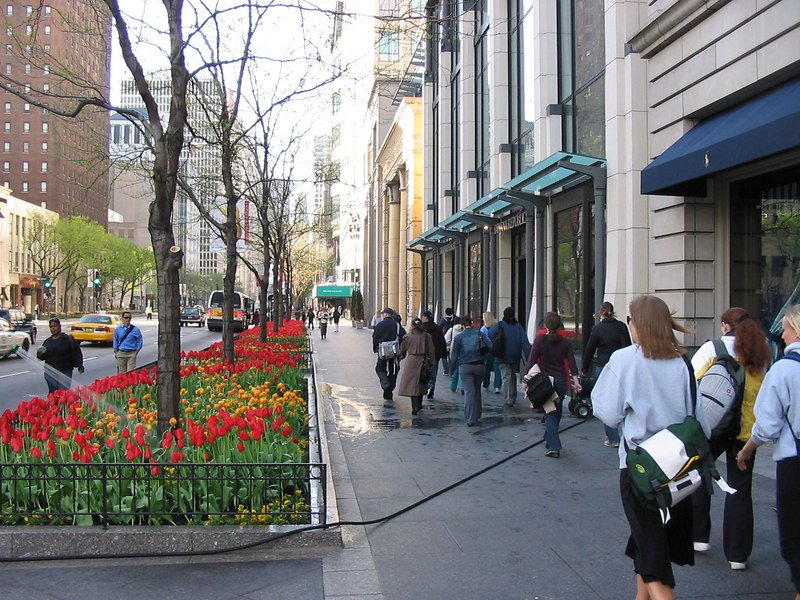
More to the point, a recent visit to the Windy City reminded us of the impact of how important it is to do the little things to beautify a city and uplift city living. We found it impossible to keep from smiling when confronted with hundreds of thousands of tulips that seemed to burst forth on every major downtown street.

It seems that Mayor Richard Daley has no intentions of resting on his laurels, but continues to fulfill his promise to make Chicago the “greenest city in America.” There are now more than 70 miles of roadway medians stretching out into the city’s neighborhoods that are green and blooming, not to mention the more than 500,000 trees that have been planted during Daley’s terms of office.

Meanwhile, Millennium Park has become the city’s most beloved public place, but more to the point, there’s no feeling that it’s getting special attention. The parks along the lakefront are beautifully maintained and city government is constantly upgrading the more than 1,100 parks, recreational areas and beaches that it is responsible for.

Park Power

If you’re ever wanting to see the power that parks and green spaces have to enliven the pulse of a city and the lives of its people, go no further than Chicago. At a recent meeting of CEOs For Cities, the Trust for Public Land’s Will Rogers made the point that cities are the midst of a green renewal, turning to their parks once again as the threads binding together the fabric of community.

In this way, it can be said that parks are increasingly the canary in the coal mine. If a city’s government is healthy and effective, it shows in the parks. If city government is not healthy and effective, it shows there first…in poor maintenance, in overgrown playgrounds and in trash left for weeks at a time.

Chicago invested in a different reality at a time when no one would have ever predicted that its future would be associated with such remarkable green strategies.

More Flowers

Cities that do it right make it look so simple, as the tulips down Michigan Avenue reminded us. Too many cities, like our own, cut parks’ budgets and pursue new arenas and big showcase projects, when often what we need most to make us prouder of our city and happy to be part of it are flowers.

A recent New York Times article said it all: To Revitalize a City, Try Spreading Some Mulch. Some times, it’s that simple; the most basic things can make the most difference.

Here’s an excerpt from the article: “…mulch is an organic metaphor, tying together the various pieces of Chicago's novel development strategy, praised by the Sierra Club and the Chamber of Commerce alike. By wrapping its arms and famous big shoulders around its Latin motto — Urbs in Horto (City in a Garden) — Chicago has become a global model for how a metropolis can pursue environmental goals to achieve economic success.

“During the last decade, the city's performance, measured in virtually every conventional category of civic well-being, has been off the charts, local boosters say. Chicago attracted more than 100,000 new residents, added tens of thousands of downtown jobs, prompted a high-rise housing boom, reduced poverty rates, built thousands of affordable homes, spurred a $9-billion-a-year visitor and convention industry, and transformed itself into one of the most beautiful cities in America.
“The generator of Chicago's mulch is Richard M. Daley, the unorthodox and popular Democratic mayor who took office in 1989 vowing to replant the urban forest of his youth that was lost to Dutch elm disease and other blights. At the time, the pledge raised the eyebrows of supporters and critics, who chalked up the mayor's love for trees to his birth on Arbor Day in 1942.

“The tree planting, though, evolved over Mr. Daley's five terms into a much more sophisticated understanding of the benefits — including to the city's treasury — of conserving resources, saving energy, expanding parks, constructing environmentally sensitive buildings, reducing the amount of storm water, restoring wetlands, generating renewable energy and doing everything feasible to heal instead of harm the city's natural systems.

“Over the years, Mayor Daley's plan to turn his hometown into the "greenest city in America" has ceased to be an unusual experiment in revitalization. Instead it is seen by urban policy specialists as an effective response to the rapidly changing expectations that business executives and residents, especially young professionals, have for cities.

“The Daley administration has planted 500,000 trees, is putting up the most energy-efficient and environmentally sensitive municipal buildings in the country, has agreed to provide developers with much faster permits if they construct green buildings, instituted a $600-million-a-year program to repair neighborhoods and city parks, promised to obtain 20 percent of the electricity used by the city from clean and renewable sources, and converted hundreds of abandoned and contaminated properties into new businesses.”

Tuesday, May 30, 2006

Action, Not Press Conferences, Will Restore Public Confidence

Sometimes it’s easy to feel sympathy for our elected officials who, spending their lives in the hothouse that is Memphis politics, try to do something to show action, and in the end, it does just the opposite.

That’s what we thought when we read The Commercial Appeal article about today’s high-profile press conference on yet another crime prevention “initiative” for our community.

While intentions were good, and participants candidly acknowledged that they were reacting to the growing community outcry about rising crime, the public probably would have reacted better if the news coverage was to announce the results of actions that had already been taken, rather than about multi-layered plans for the future and a summit six months from now.

The plan, dubbed Operation Safe Community (if government wants to save money, it should shut down the committee that comes up with these names), was replete with buzzwords and stern talk, but in the end, it was lost on the participants that another press conference might not be the most effective way to send the message that we’re getting tough on crime.

After all, many of these same elected officials have had press conference in previous years on some of these same issues, notably Attorney General Bill Gibbons, who has been firing off press releases claiming credit for cracking down on gangs and domestic violence for years now.

Much of the “ambitious anti-crime initiative” seemed to be new packaging for favorite agenda items – reinstatement of the domestic violence court, a push for more and more gun crime laws, attacks on gangs and help from faith-based programs. There was something for everyone, and since The Commercial Appeal published an editorial praising the effort on the same day that the press conference story was printed, it’s pretty clear that the initiative will have a big-time cheerleader behind it.

Watching the elected officials announce that the program will make Memphis one of the safest communities of its size in the nation by the end of the decade, it was hard not to think it's too bad that the announcement wasn't made in the last decade, because some of leaders were in office then, too. Perhaps that why Attorney General Gibbons and Mayor Willie W. Herenton were happy to let new U.S. Attorney General David Kustoff take the lead, and that was good news, because he brings some fresh eyes and new thinking to these strategies.

While others were handing out bromides like “together, the community has the resources to fix it… we just need to engage the community” and “it’s going to take the rest of the community to step in,” Mr. Kustoff spoke directly, admitting there are “no easy, push-button answers.” Just telling the public like it is seems to be a dying art form, but the U.S. Attorney's candor is refreshing and encouraging.

There is broad consensus and concern within the political community that the public is fed up with crime. They are tired of the level of crime that they have to accept as a normal part of their lives. They are tired of police officers treating stolen cars as our birthright and unworthy of finger printing.

Most of all, the public doesn't want to be told that they are the answers to fighting crime. They are paying more than $250 million a year for law enforcement and criminal justice, and simply put, they want something to show for the investment.

There are a number of things that can be done that would produce a much-needed boost in public confidence for its law enforcement agencies, chiefly visible enforcement and some press conferences about actual results of new programs, rather than announcements about new plans.

The depth of public cynicism is as deep as most observers have ever seen it. Hopefully, elected officials will downplay press conferences and press releases, and perhaps even forego plans for another summit.

The sentiment of the public is unmistakable. They want to see action and results. Just do something, anything, they say, and hopefully, somebody at the podium is listening. So much is riding on it.

Friday, May 26, 2006

The IDB Parallel Universe

Government officials and agencies have an aversion to admitting they’ve made a mistake, but no agency is more tone deaf than the Memphis and Shelby County Industrial Development Board.

Case in point. Yesterday, on the same day that Shelby County Mayor A C Wharton was in Nashville, engaged in hard-nosed negotiations to get more revenues for his cash-strapped government, the IDB is at the same time giving away $820,000 in taxes for two more questionable applicants.

Being stubborn is one thing, but the board’s actions have long since reached the stage of irresponsibility. Not only does its continued rubber stamping of tax freezes fly in the face of the opinions of most taxpayers, but it’s just simply bad public policy. Period.

Unfortunately, in recent months, there has been a lot more talk about reining in the board’s authority than action. Normally, talk is cheap, but not in this case. While city and county governments debate what should be done, the IDB simply goes on its way, with each approval adding to the $50 million a year in taxes already waived in Memphis and Shelby County.

Meanwhile, in Nashville, the county’s mayor has to suffer the indignities of going to Capitol Hill, hat in hand, to plead for the state’s largesse in granting him a new tax on development. In the end, he is able to get $5 million this year, or roughly the equivalent of 10 percent of the total amount being waived by tax freezes annually.

An Oblivious IDB

The IDB meanwhile acts as if it’s oblivious to the way that it is compounding the financial woes of city and county governments. It is so single-minded that it sees no broader responsibilities to the community, such as using tax freezes only when absolutely necessary to close a deal for quality jobs in a targeted industry.

Yesterday, the board gave preliminary approval to two more pedestrian applicants – one with a habit for posting losses and another in the habit of paying welfare wages. The new jobs created by the companies actually drag down the per capita income of Shelby County, because the average salary of one company was $32,000 and salaries at the other company average $22,880, both below the county’s per capita income of $34,000.

So, clearly, it’s not the strength of the salaries that got their taxes waived. Rather, it must have been the capital investments of $4.2 million and $2.1 million, once again making the point that the PILOT program is a real estate development program masquerading as economic development.

The company paying the average wages of $22,880, Knox St. Clair, a supplier of interior doors and windows, is paying so little that its 32 new employees will be eligible for food stamps and human services on the day they start their new jobs. In other words, taxpayers are not only subsidizing the company’s bottom line with the tax freezes, but we may also be subsidizing it by providing its employees public assistance, public health and human services programs.

These kinds of tax freezes say volumes about the IDB’s long-term vision of Memphis and Shelby County as a center for the low-wage, low-skill jobs that it so easily approves. It certainly didn’t engender any great feelings of pride for us when an official with one of the companies took his tax freeze and praised Memphis’ “highly-skilled distribution workforce.” That, in a phrase, is the legacy of the IDB.

Low-wage Jobs

In effect, the low-wage jobs being given tax freezes have hidden costs, and as we’ve suggested before, the evaluation for all tax freezes should include all public costs, not only of roads and interchanges, but public health care costs, utility subsidies and housing assistance for low-wage employees.

In Minneapolis, for example, companies seeking business incentives must provide the names of all programs to which they are applying, profiles of their workforce, projections of future wages and the total cost of public assistance for their workers.

Amazing as it sounds, there is no effort to connect decisions about PILOTs to a more comprehensive, overall plan and to place the emphasis on areas where the existing infrastructure had already been paid for by local taxpayers. As a result, PILOTs approved by the IDB cause local government to spend more money to build roads, bridges and sewers, however, these factors aren’t considered in the evaluation process.

That’s why we have made our own recommendation. Every PILOT should have a “fiscal note” that tells not only the amount of taxes being waived, but any other costs that will have to be incurred by taxpayers, whether it is for a new road or food stamps for workers.

Investments

Decisions about tax freezes shouldn’t be made in isolation, and if we are to act as investors, we are entitled to know the entire investment that we are making in each company.

The heart of our economic development policy should be increased opportunity, better jobs and bigger paychecks. Tax incentives should be aimed at achieving all three objectives, because if government is a party to a process that puts its own citizens in low-wage, dead end jobs, it is not just bad public policy. It is the most cynical kind of public policy.

That’s why it’s disheartening that the common sense recommendations of the consultants who studied the tax freeze programs continue to languish five months after they were issued and business as usual continues.

At the end of the day, the recommendations go a long way to putting the emphasis on tax freezes where it belongs – back on an understanding that this is the public’s money, and it must be invested wisely and in a more targeted way.

Wednesday, May 24, 2006

Shelby County Schools' Political Payback Only Hurts Students

It’s always the innocent bystanders who get shot.

That’s especially true in school politics, where the ultimate victims are always the students.

Recently, in the latest salvo from the Shelby County School Board, Memphis City Schools was notified in a letter from county superintendent Bobby Webb that 155 students in an area being annexed by Memphis cannot attend county schools next year in keeping with past practice.

Sometimes, it just doesn’t seem possible for the county school system to exhaust its supply of pettiness and cheap shots. The letter seems to come from the same place as the outbursts by County Schools Chairman David Pickler following Memphis City Schools’ refusal to support legislation before the Tennessee Legislature that would have made the county system into a special school district.

Reciprocity

As we pointed out April 14, there were major political obstacles to the city schools’ support for the special district, primarily connected to the question of what benefits, if any, would Memphis City Schools receive from lobbying for the legislation. In the end, there was no benefits and it did nothing to support the special district, igniting an overheated hue and cry from Shelby County Schools which complained that its city counterparts had violated an agreement and a newly minted spirit of comity.

It’s a tendency of the county schools to see their interests as the center of the educational universe and to pander to their constituents, but we’re hard-pressed to imagine how they missed the call so badly on the special school district. Even a political novice could have predicted that unless there was some reciprocity for Memphis City Schools, there was little reason for it to support this change.

It was a telling indicator of how poorly the county district handles issues that require serious negotiation and compromise. Memphis City Schools’ officials contend that they never made a commitment to support the state legislation, and privately complained that they felt that Shelby County Schools had tried to bully them with Memphis Tomorrow’s approval of the special district.

All that’s just background, but apparently, as a show of their displeasure and pique, the county district decided to send a message. Unfortunately, it came at the expense of students living in the Southwind-Windyke annexation area.

The 155

There are 155 of them – 81 in elementary school, 44 in middle school and 30 in high school. In the past, Shelby County Schools has allowed for a transition period up to several years for students to move from their present schools to city schools. In addition, students in the 11th and 12th grades – and sometimes the 10th – have been allowed to graduate from the school they attended at the time of annexation.

But no more.

In an effort to show its muscle, the county school system gave Superintendent Carol Johnson one week’s notice that it would not be allowing a transition period for the 155 students in this year’s annexation area. It’s one week’s notice for the superintendent to plan for them. This week, the county district will notify parents of its decision, forcing their children to move next fall from schools in Germantown to schools within the Memphis city limits.

Under Capacity

Most incredibly of all, the students being removed from Germantown High School are now in a school whose dominant characteristic is that it is under capacity and will be even more so in the future. In other words, the county system could easily have allowed these students the opportunity to complete high school in the present school they are attending. By the way, the grand total of students who would have been seniors at Germantown High School next year is 10, hardly a problem for a school about 200 students below capacity.

Instead, today, Memphis City Schools is unexpectedly trying to find places for these students in its schools. Some of the obvious options are Ridgeway High which is 147 percent over capacity; Ridgeway Middle School, 111 percent over capacity and Ridgeway Elementary School, 110 percent.

Prepare yourself for the county system's normal claim that its school are overcrowded, but as usual, its statistics would have made Enron proud. Not only is Germantown High School under capacity, but so are Germantown Elementary (about 40 students) and Germantown Middle Schools (about 250 students).

All in all, even in a political environment known for its adversarial positioning, the county’s position is spiteful to the extreme. And sadly, its willingness to use students as pawns for its political agenda says more about its commitment to education than any amount of speeches that its officials can give.

Annexation

The area being annexed is, roughly speaking, an oddly shaped area north of FedEx World Headquarters and east of Hacks Cross Road, a sliver of land that runs east along Hacks Cross Road and then eastward along Nonconnah Creek, and an area that is essentially Windyke.

These areas were immediately annexed, but most of Southwind and the area west of Wyndyke will wait to be annexed until 2013 in an agreement entered into by The City of Memphis. Looking at the annexation plan, it’s hard to find the logic in it. Some areas are leapfrogged for no apparent reason except they are largely single family residences and given a seven-year reprieve in city taxes.

Politics is a contact sport, but some things should rise above the normal daily political gamesmanship.

Fair play for these 155 students is surely one of them.


Monday, May 22, 2006

Funky Memphis Keeps Hottest Music To Itself

From the Hollywood Reporter comes this reminder of the most important asset of Memphis Music - the music being created right now - and why we need to do a better job of showcasing and supporting it. If we're looking for the best indicator of success for Memphis Music, it's measured by the money being put into the pockets of today's musicians, not merely the numbers of tourists visiting yesterday's sites:

Interesting town, Memphis. I was reacquainted with that fact when I spent 10 days there early this month on what I laughably called "vacation."

I went down to the Bluff City to attend the annual Beale Street Music Festival and the fifth Ponderosa Stomp, temporarily relocated from New Orleans to Memphis this year (HR 2/23). I also poked around the city's small, noisy, smoky bars and schmoozed with the locals.

I was reminded again that there are two Memphises. The one most people know is the city of Graceland, the redeveloped and Disney-fied Beale Street and such sites as the Stax Museum and Sun Studios. (Hi Records, home of Al Green, does not yet have its own shrine, but give it time.) Elvis, rockabilly, Southern soul -- that heritage continues to draw the tourists.

But the rock music made in today's Memphis remains largely invisible to out-of-towners. It doesn't make it downtown, but you can hear it almost any night in the city's midtown joints.

I managed to catch some astonishing stuff. Local indie goddess Alicja Trout, who fronts three bands, played a thrilling set Friday at Murphy's with the quintet Mouserocket. A Recording Academy event Saturday at a downtown warehouse showcased Secret Service, a punchy, Southern-fried hard rock band featuring guitarist and second-generation Memphis musician Steve Selvidge, and Brad Postlethwaite & Friends, a new project by a member of the chamber-rock collective Snowglobe.

You probably have not heard of any of these fine performers, for contemporary Memphis rock seldom makes its way outside the city limits. It's only the rare act like the North Mississippi All Stars and Lucero who get on the national map.

Memphis almost is a Bizarro World version of neighboring company town Nashville. Infrastructure? Forget about it. The only thing Memphis has a lot of is studios. Well-capitalized indie labels are few; many performers issue music on their own hip-pocket imprints. Managers, attorneys and booking agents also appear in short supply. And who's the top "rock" seller this week at local indie distributor Select-O-Hits? Jimmy Buffett.

Add to this mix a generalized suspicion of the musical establishment by the town's indie-rockers, and an equally pronounced apathy on the part of local audiences and city fathers, and you have a musically robust community that remains steadfastly balkanized commercially.

It might be left to the city's rap community to lead the rock brethren out of the wilderness. Three 6 Mafia's surprise best original song Oscar win for their "Hustle & Flow" track "It's Hard Out Here for a Pimp" made a nationwide impression, and homeboy Al Kapone, whose "Whoop That Trick" also is heard in Craig Brewer's film, continues on the rise.

During the Beale Street fest, Kapone performed a rambunctious set backed in part by the Bo-Keys, an indie-rock/funk crossbreed that includes Stax vets Skip Pitts, Ronnie Williams and Willie Hall. The band is led by bassist Scott Bomar, who scored "Hustle & Flow" and is composing for Brewer's upcoming "Black Snake Moan."

Watching the rappers and instrumentalists interacting so vibrantly onstage in Tom Lee Park, one began to dream that a new day of cooperative black and white music-making could birth another glory era in Memphis. Here's hoping, y'all.

Friday, May 19, 2006

Full Frontal Assault On SOB's Is Called For If Change Is Going To Come

Yesterday, Memphis City Council and Shelby County Board of Commissioners had one of their infrequent joint meetings to discuss a bothersome issue for Memphis – the S-O-B’s.

The news they got was B-A-D.

In this case, we’re referring to S-O-B’s as in sexually-oriented businesses. The news from the consultants hired by the Office of Planning and Development was startling: Memphis is in the top three cities in the U.S. for “anything goes” in its sex clubs.

It’s not what the local legislators were expecting to hear, judging from the grim looks and incredulous comments. But then again, it’s been one of the worst-kept secrets in Memphis that strip clubs here are famous for their uninhibited, graphic behavior.

Over the years, there’s been periodic talk about regulating SOB’s, but it always fades away as suddenly as it begins. Normally, the public’s ire about this issue is raised when a business considers a suburban location. A double standard is seen when it comes to the rest of the city, and despite the talk, there’s been very little done to control the clubs on any level.

Three-time Loser

In that regard, Memphis is a three-time loser, failing in regulation, licensing and zoning. Put simply, it should really come as no surprise that things are completely out of control.

The nationally prominent consultants, after visiting Memphis’s sex clubs, said that Memphis is in the major leagues in public obscenity. Few cities rival ours, and the consultants’ recent work in Detroit showed that the city pales in comparison to Memphis.

In the clubs here, sex is ever present and ever available -- any kind, any way, any cost.

If you want food, you go to the kitchen and order it from the cook, because the woman serving your table is delivering services, but it’s not food. There is “full body contact” between male customers and female dancers on stage, frequently moving to a back room to complete the exchange of cash and bodily fluids.

In other words, if you’re wondering what takes place in these clubs, let your imagination run wild. You’re probably not imaginative enough to compile the list of activities taking place there.

The problem is basic. There are no checks and balances and no serious consequences in the current regulatory system.

Beer Board

The Memphis Beer Board – the regulatory body over these clubs – repeatedly slaps club owners on the wrists, collects the fines that it needs for its operations and sends the club owner back to his business. To the club owner, the fine is just another routine cost of business.

Unlike some cities, in Memphis, there is no “three strikes and you’re out” regulation, but even if there were, it’s hard to see the Beer Board applying it.

Here’s the normal scenario: someone is arrested inside a club for drugs or prostitution, usually by one of the only seven vice officers with Memphis Police Department. Notification of the arrest goes to the beer board, which shows a lack of concern that is as much of its make-up as its politically appointed members.

The Beer Board is headed up by Reginald French, plugged-in political operative and Democratic candidate for Shelby County Sheriff. Past performance of the board certainly does nothing to polish his law and order credentials.

Lessons from other cities show that the ones that have been effective in handling the SOB’s rely on a combination of aggressive enforcement of criminal obscenity laws and the type of stringent regulations that the consultants have written for other locales.

National Consultants

Eric Kelly and Connie Cooper, the consultants advising city and county planners on a course of action to control these clubs, have national credentials, and their work has been instrumental in other cities successfully balancing First Amendment issues with the interest of a community to regular SOB’s.

In fact, they wrote the book on this problem. Literally. It’s titled “Everything You Always Wanted to Know About Regulating Sex Businesses,” and it was released by the American Planning Association.

They tends to reject the term “adult entertainment,” a marketing term invented by the pornography industry, in favor of sexually oriented businesses, because it provides a useful acronym for these enterprises, which pose public health and safety hazards.

They describe activities in Memphis clubs as coming close to legalized prostitution, and it is this aspect of the clubs’ operations that are most troublesome, because two clubs are owned by rival gangs whose dancers may be coerced into working there.

They acknowledge that municipalities can’t legally prohibit sexually oriented businesses from building within their borders, but they can regulate where they are built, such as in commercial or industrial areas and away from schools, parks, playgrounds and churches.

Themes

Although recommendations from Mr. Kelly and Ms. Cooper won’t be presented until next month, several themes have already emerged in meetings discussing what could be done to help with this problem in Memphis. One, regulatory oversight should be removed from the ineffectual Beer Board and given to a public agency prepared to enforce and punish; two, existing zoning ordinances need to be fine tuned to restrict the location of these clubs and their operations; and three, clubs should be required to get a license or permit.

Surprisingly, none of the clubs is required to get a permit to get into the sex business. The required permit is to sell beer and food only, although the dancers have to get a permit. To compound enforcement efforts, if codes enforcement officials cite the businesses into court for violations, the maximum fine that can be levied against them is $50, because the Tennessee Legislature has refused to allow higher fines for code infractions.

Meanwhile, there are primary three local owners of these SOB’s, and they interchange ownership frequently with quit claim deeds so that codes regulations can’t be enforced in any meaningful way. Every time property ownership is changed, the clock starts running all over again.

Change

In other words, there are plenty of changes that need to be made if Memphis is to get serious about these problems, but the ability of cities to have some control over these businesses has widened as a result of U.S. Supreme Court rulings over the past 20 years.

Lately, the Office of Planning and Development has been showing a more aggressive side in its leadership, bringing in nationally known experts to help with issues from tax freezes to Broad Street revitalization to a new development code to sexually-oriented businesses. But high-quality information means nothing if elected officials don’t act on it.

Mr. Kelly and Ms. Cooper have exposed the ugly underbelly of Memphis to the light, and hopefully, government officials will take strong action to control the illegal activities in these clubs. Not only is it needed to address public health and safety issues, it’s needed to eradicate the ugly whispers in the halls of government about influence exerted by these club owners.

In the end, that’s the most insidious problem of all.

Thursday, May 18, 2006

New Orleans' Lessons Could Have Memphis Applications

The following is the City Journal column in the May issue of Memphis magazine by Smart City Consulting's Tom Jones:

Spray painted on a New Orleans wharf warehouse near the Lower Garden District: “Next time, we vote for somebody who cares.”

Nearby, inside the 79-year-old po’ boy restaurant, Domilise’s, Karen, a petite 63-year-old with deep family roots in Louisiana, says: “Our form of government doesn’t work anymore, and it’s not worth saving. When there’s no accountability and no responsibility, what good is it?”

The room nods in agreement. No one even bothers to narrow it down to a specific government. Every one seems to agree that it applies to all of them – federal, state and city.

There’s an air of revolution in the small, cramped restaurant. It’s not that such emotions are unusual for New Orleans. Rather, it’s the sense that people aren’t going to take it any more and mean to change things.

Turnaround

It’s a dramatic turnaround for New Orleans, where the air has always been heavy with the aroma of good food and with fatalism about public corruption. The city has always been the city equivalent of an Internet chat room, where people could reinvent themselves and their past. This time, the people seem determined instead to reinvent the city and its future. Activist groups are springing up with a regularity usually reserved for new restaurants.

After initial resistance, Governor Kathleen Blanco was met with a blistering assault from the Citizens for One Greater New Orleans, and she reversed course, leading the fight to reform the levee boards that had come to symbolize all that is wrong with New Orleans government – favoritism and corruption, ineffective and short-sighted.

The “One Voice” movement also got the attention of Mayor Ray Nagin, businessman turned government reformer, who supported the group early and often. However, he was assailed by many for his clumsy political rhetoric and his lack of understanding that being mayor is more about being a leader than a manager. Many of the grassroots activists are campaigning against his reelection.

But the most intense vitriol is aimed at the federal government, and rather than ebbing over time, it seems to grow in intensity as headline after headline chronicles federal officials who are out of touch and inept, giving Congressional elections new importance. Leading the charge is the Times-Picayune, a powerful reminder of the impact that exceptional newspaper reporting and impassioned editorial writing can have.

Why does this matter to Memphis?
Because we’ve always had more in common with New Orleans than river and music. Frequently, we’ve looked to the Big Easy to glimpse into the future. Because of the strikingly similar demographics in Memphis and New Orleans, that city has always been the place where we could look to see what could happen if we didn’t deal with problems. No matter how bad poverty, teenage pregnancy, student performance, infant mortality or the disparity between white and black family incomes were in Memphis, we could always count on it being worse in New Orleans.
Now, all that has changed.

For the first time, we may be able to look to New Orleans for something other than a worst case scenario. Yes, there are the obvious lessons that apply to us, such as the need for a disaster communications system based on up-to-date, reliable technology; completion of the emergency preparedness plan that seems to be never ending and for seamless coordination between our troubled Homeland Security Office and our undermanned Emergency Management Office.

Big Picture

Beyond these kinds of lessons, however, New Orleans is a petri dish for innovations in city-building. The “big picture” issues pivotal to a 21st century New Orleans are just as pivotal to our city:

· Make its future known for smart growth, rational land use and high-quality design

· Create a shared vision for economic development that shifts the economy from low-skill to high-skill and from tourist-centric to talent-centric

· Enact a development code that binds together a city too often divided by race and that encourages density and mixed use, mixed income, walkable neighborhoods

· Capitalize better on universities as engines of economic growth and innovation and as neutral ground where unifying plans for the city can be developed

· Encourage newfound citizen involvement by formalizing a process that invites new voices and new people into the public process

· Build a wireless city where connectivity and communications – keys to the future - are omnipresent

· Anchor the future in today’s musicians by providing housing incentives, practice space and financing

· Build a “green,” environmentally sensitive ethos seen in planning, energy efficiency, construction codes, architecture and a network of parks and outdoor recreation

· Build a transportation system that emphasizes bicycles as much as streetcars and includes a light rail system

In the end, for New Orleans to succeed, it must raise the bar. Blown away with half of the city was citizen apathy, and Katrina left New Orleanians with little choice but to rethink how they want to live in their city and how to make it happen. Maybe Memphis can learn enough from its sister river city to start building a future of innovation on our own. Pre-earthquake.

Tuesday, May 16, 2006

Agricenter President Could Usher In A New Era Of Communication and Cooperation

John Charles Wilson is a breath of fresh air.

In an interview with The Commercial Appeal, the president of Agricenter International admits what others there have refused to face for years. The facility’s founding vision and promises have failed.

In describing what was supposed to be a national center for agricultural technology and research, Mr. Wilson told about how much children enjoy the place today – with its pay-to-fish lake, its eight-acre corn maze, its fishing rodeo and his community outreach programs to teach forestry and farming to students.

While all of these activities sound like fun, it vividly paints the portrait of a facility that fits more into the framework of a regional park than an isolated facility commanding 1,000 acres of public land like a feudal lord.

Justification

Of course, no one at Agricenter mentions any more their 1981 justification for public funding: Agricenter International will be a “regional resource and technological center for all aspects of agriculture…a showplace for cutting edge technology and equipment…a repository for information in a state-of-the-art data bank…a prominent center for innovative research…the site for permanent and changing exhibits…and the host/sponsor/organizer for significant agricultural conferences, seminars and conventions on emerging themes.”

Now, cheerleaders for the facility have lowered their sights, pointing to its importance in giving kids a chance to experience farm life. Left unsaid is why that requires 1,000 acres of the county’s most prized land at Shelby Farms Park, or if this is the highest and best use of a building that’s received more than $20 million in public subsidies.

Once the organization was disconnected from the financial artery of county government about 10 years ago, Agricenter International could no longer count on deficit funding each year from the public sector, and in its haste to reinvent itself, it floundered for years before it arrived at its present focus anchored in youth activities.

A Mixed Bag

It still has its mixed bag of events held in the building. Most have only tenuous connections to its agricultural mission. Lately, one of its biggest events was the Southern Women’s Show, and the newspaper coverage said that 22,000 people in three days attended the show. What it failed to mention is that Agricenter International stole the event from the Memphis Cook Convention Center, where it had previously been held. This in turn reduced revenues at the convention center, a building where the city and county governments are still responsible for deficit funding.

We are told that events rentals account for about 33 percent of the facility’s revenues; office rent accounts for about 20 percent; 10 percent from crops and the remainder from miscellaneous activities.

In its Valentine to the Agricenter, The Commercial Appeal quoted the economic impact study by Younger and Associates that the Agricenter generates $527 million in economic spin-offs. It makes that same firm’s prediction that the NBA would produce more than $1 billion in economic impact almost seem reasonable.

Based on the facility’s annual revenues of roughly $2.5 million, it would mean more than a 250:1 return on investment. Besides demonstrating once again how utterly meaningless these economic impact studies are, the report is merely a distraction from key decisions that need to be made about Agricenter’s future.

Over the years, Agricenter has shown an institutional inclination to stonewall any questions about accountability, shift in mission, iron-gripped control over the 1,000 acres or even modest proposals for greater coordination between the operations of the park and the facility.

Staying Alive

But our intent is not to beat up Agricenter International. That’s much too easy. Our purpose is to acknowledge that it is in fact an organization trying to stay alive despite the failure of its original mission. That happens to a lot of organizations, and even critics of the facility have to admire Wilson’s dogged determination to find a niche and his enthusiasm for his job.

However, it does seem time to address some critical questions about Agricenter International.

For example, it’s time for Shelby County Government to re-visit the resolution which turned over 1,000 acres to the organization. The fruits of that resolution -- a hodgepodge of buildings creating an eyesore along Germantown Road, a desolate RV park, a decrepit old farmer’s market building, an architecturally jarring ShowPlace Arena, and a series of buildings whose who look no more permanent that the trailers parked nearby – call out for a fresh look at the relationship between county government and Agricenter and a more logical allotment of public land.

Mr. Wilson exhibits rare honesty in explaining Agricenter’s activities, so perhaps, his leadership can usher in a new era of openness in considering these issues.

Saturday, May 13, 2006

Memphis' Best Future Begins With A Dose Of Reality

Memphis is in trouble.

There, we’ve said it. Please tell us we’re wrong.

We have traditionally been dependable cheerleaders for Memphis, but right now, we’re hard-pressed to feel like our team is even in the major leagues, much less competing there.

This jolt of reality slapped us in the face when we read Forbes’ always influential rankings of the “Best Places: 200 Places Rated For Business.”

It wasn’t pretty.

Sometimes in Memphis, it’s as if we’re the city equivalent of the frog sitting in the pot on the stove as the water gets warmer and warmer until it’s boiled to death.
We rationalize away the low Milken ranking or a poor showing on another competitive list. We justify our lack of impact on the “Places Rated” types of rankings. We dismiss a negative Tennessee study or a national Brookings report.

All the while, we’re slowly boiling to death.

The Forbes magazine jolted us off the stove.

Of the 200 largest metro areas, Memphis ranks 98th on the list of “the best metros,” according to Forbes. As a wake-up call, just consider that Nashville is in the top 10 – ranked at # 7.

Span of Success

But it’s not just our natural competitiveness when it comes to Nashville. It’s the impressive performance by a number of places located roughly between the 34th and 36th latitudes.

Besides Nashville, there’s Raleigh at # 2, Durham at # 8, Charlotte at # 24, Asheville at # 24, Knoxville at # 5, Fayetteville at # 9, Little Rock at # 22. Tulsa at # 43 and Oklahoma City at # 13. Albuquerque ranks # 1.

Yet, as your eyes sweep eastward to westward along this “span of success,” there is Memphis, mired down in 98th place. A non-player. A no-show in the big leagues. A non-factor in business decision-making.

And yet, Memphis is not mired down in the bottom rungs in all categories. We’re in the top 10 in one. Unfortunately, it’s the list of the most crime-ridden cities. Only one other metro area in the entire U.S. has more crime. We are # 2.

In the past, I admit that I’ve tried to justify the impact of these devastating crime statistics by pointing at Atlanta, which has always been a hub for economy vibrancy and a magnet for talent, although it’s had one of the highest crime rates in the country for years. Yet, I realize that I’m only whistling in the graveyard.

The difference between Atlanta and Memphis is in national positioning. Atlanta has a news network broadcasting from its headquarters there, it’s constantly held up for the lessons of its economic boom, it has the nation’s most impressive park project under way and it never seems to rest on its laurels.

Information about Memphis comes largely from articles and lists like the one in Forbes. There is little countervailing information about Memphis, so our city becomes defined by the negative, defined by others.

We know it’s not all bad news. Memphis Bioworks Foundation is doing impressive things. St. Jude’s is known for its breakthrough research. FedEx is well, FedEx, and thank God it’s located here (although it has boosted operations in other cities because of workforce issues here). There are some nationally significant innovations on public issues inspired by the philanthropic community. The Memphis Regional Chamber’s new leadership grasps the importance of our city having strategies to attract talent.

Fundamental Problems

That said, the mayor is essentially invisible, emerging periodically to announce that he’s running for reelection and talking about his legacy. Sadly, it seems that the more he talks about his legacy, the worst it gets.

Rather than investing taxes to strengthen our urban core, our elected officials made the choice to take these taxes and use them to pay for sprawl that is financially and socially devastating. In other words, Memphians have been made to pay for the policies that led to the deterioration of their own neighborhoods.

We worry about the infrastructure for a distribution economy when we need to create infrastructure for a knowledge economy at a global scale. We have a propensity for chasing low-wage, low-skill jobs and even rewarding them with tax freezes in an age when cities competing globally are doing it with high-skill workers. We are obsessed with competing with DeSoto County when we need to be considering ways to compete with regions on other continents.

We have no over-arching public policy vision, complete with action steps and measurements. Crime is a good example, where we’re lulled to sleep by the barrage of press releases out of the state attorney general’s office and the lack of leadership from the director of police. No one seems to care that the birthright for young black boys in this city is jail, not college, and that there are ways to deal with the symptoms, not just the causes. Through it all, there’s no demand for action or attention from City Hall.

List after list of urban indicators paints the picture of Memphis as a troubled city, and we continue to drop in key benchmarks.

Boiling Water

So, why did we feel the water beginning to boil?

We just attended a national meeting of urban leaders for about two dozen cities. They talk of innovation, they talk of new public policy, they talk about new thinking and they describe bold, new actions that they’re taking.

They look blankly when Memphis comes up in conversation. It’s as if either Memphis doesn’t exist on their landscape of progressive cities, or they’ve already given us up for dead.

And yet, there much that can be done to turn things around.

But the first thing we have to do is to realize that the water is boiling.

Monday, May 08, 2006

Need For Coalition For A Better Memphis Extends Beyond Election Season

Primary elections are about a candidate identifying a base and talking about the red meat issues that its members care about. The general election is about broadening the base to appeal to more than the true believers.

Unfortunately, in county elections here, we rarely have the second phase, because districts are so carefully drawn to preordain them to one political party or the other. As a result, there’s normally not even a challenger from the other political party in places like the Republican suburban district or the Democratic urban district.

This is why while there are 13 county commissioners, only three have opposition on the August general county ballot, and political insiders only see a serious contest in one of them.

As a result of the party interests institutionalized by the partisan county elections, candidates normally are frozen in the first phase of a campaign, the part known for its partisan rhetoric, such as every Democrat railing against privatization or every Republican promising to lower taxes.

Unfortunately, because there’s normally no general election where candidates from both parties compete to sell their differing viewpoints, there’s little pressure for most candidates to move beyond the partisan rhetoric to develop substantive plans for Shelby County Government.

We never learn how the Democrat plans to hold down the costs of government if an operational option like privatization is summarily taken off the table. We never learn how the Republican is going to vote against every tax increase while encouraging suburban sprawl.

It was in response to this parallel universe that The Coalition for a Better Memphis was created and why it is such a welcome development. This year, as promised, the Coalition “qualified” candidates running for county commissioners and announced their “grades.”

But, perhaps, The Coalition for a Better Memphis would serve the community’s interests best if it did more than just weigh in at election time. Rather, it could seriously elevate the political debate if it stayed engaged after the election, pressing winners for detailed plans of action.

So far, in the interview process, some candidates have gotten away with offering up the normal hyperboles and vague (if sometimes conflicting) promises. It happens when the questions are general and the grading process isn’t precisely spelled out. (In some races, it was arguable that candidates got the highest grades when they said the least.)

Backers of the Coalition concede that the organization has some work to do before its next entry into the election process, however, it was a promising first step that the Coalition took with the county commissioners’ elections.

Yes, in truth, its impact was probably limited, and there are deep suspicions by some political activists that the endorsements were predetermined. But such complaints were also heard when the Committee for a Better Atlanta – the prototype for the Memphis group – began its work there. The complaints were expected as a byproduct of a political scene that breeds conspiracies by the hour.

That said, for the most impact, the Coalition should make the interviewing and grading process as transparent as it can so candidates and voters understand the context that it’s using to determine if a candidate is answering “right” or not.

Back to our point about the Coalition staying engaged after the election, let it be said that whatever the Coalition can do to stimulate greater interest in local elections and increase understanding of what’s at stake is good. It’s clear that Memphis has a cancerous voter confidence problem. In the county primary elections, the turnout didn’t even manage to break into double digits.

Perhaps, if we want to engage the voters, accountability must become more than just an election cycle issue. Perhaps, the Coalition could truly transform the civic discussion by reporting back to the voters on a regular basis about whether politicians are doing what they promised.

The upside to this is that it would require every candidate who becomes an elected official to offer up specific, measurable plans for the future. It’s would no longer be enough for a candidate to answer a question about economic development by saying that he’s for more economic growth, fine turning tax freezes and looking closely at smart growth. Instead, he would have to say what he would precisely do to improve the use of tax freezes and to make growth financially sustainable.

There are no serious accountability in the process now, and the media do not seem inclined to play this role in a structured way. Here's a vacuum that the Coalition could fill, and in doing it, it would fulfill the full potential of its founding vision.

Saturday, May 06, 2006

Libertyland And Coliseum Futures Must Hit Civic Targets

Everybody’s all for government acting more businesslike until it affects their special cause. This comes to mind when we listen to some of the arguments from grassroots leaders who insist that Libertyland and the Mid-South Coliseum must remain open.

We applaud their willingness and their determination to have a voice in the public decision-making process. It’s just hard to see how they end up on the “winning” end of this debate.

First of all, there is the deliberate, inexorable movement by city government to cut expenses. The current budget woes demand it, but in addition, that’s what we voters kept telling city officials like Chief Financial Officer Robert Lipscomb that we wanted.

The city owns 60 percent of the Coliseum and apparently most of Libertyland, and it leans toward closing both and using the land for development that would be an anchor for rebirth of the area.

With the neighborhood redevelopment plans of the University of Memphis on the east and the Fairgrounds redevelopment on the west, this critical section of Memphis could then get the economic shot in the arm that it deserves. When you consider the growing strength of Cooper-Young, it is not hard to imagine a completely new set of uses for the Fairgrounds property that could bridge Cooper-Young and the neighborhoods just to the east of the Fairgrounds all the way to the U of M.

Fairgrounds Redevelopment

Redevelopment of the Fairgrounds creates a 365-day-a-year force for improvement, rather than the intermittent bursts of activity at the Coliseum and Libertyland, the deteriorating buildings whose highest and best use seems to be as sites for flea markets, and the expansive (and empty) asphalt parking lots that stretch for blocks.

In the end, discussions about future uses of the Fairground property, including Libertyland and Coliseum, need to centered on identifying the uses that can strengthen the adjacent neighborhoods, spark new investments in the area, spur economic growth and stabilize and increase property taxes.

The current uses just don’t hit the mark on any of these.

If the current uses are to remain, it seems to mean that government must throw good money after bad at the Coliseum, where the deficit now is about $400,000, and it must adopt Libertyland from the Mid-South Fair, which has been paying the thumbnail theme park’s deficits for years.

City of Memphis officials have been driving these key decisions, but a sense of urgency has developed around the Coliseum when county government announced that it wouldn’t pay its 40 percent of the deficit, causing the city to announce that the building would be closed. However, since that announcement, Mayor A C Wharton, after a meeting with renters of the building yesterday, now seems to be reconsidering. It has all the appearances of the classic political dilemma in these joint city-county projects. In truth, none of the staff on either side of Main Street thinks that it makes any sense to keep the Coliseum open, but neither side wants to be the ones that take responsibility for locking its doors.

Bring A Check

And yet, the problem seems simple. If all these tenants, who are imploring Mayor Wharton to keep the building open, want to make it happen, they need only come up with a plan for the rents to be raised to cover the $400,000. That of course isn’t practical, but then again, there are no practical options for the building’s future in the first place.

Consultants told the city and county six years ago that the building should be shuttered, unless there is someone who wants to buy it, operate it and pay all expenses. Nothing has changed, and if that recommendation had been followed, city and county governments would already have saved several millions of dollars.

Keep in mind that the city and county governments don’t pay the operating deficit at FedEx Forum, and it seems to be a prevailing trend in city governments around the country to get out of the building management business. It’s just not something government is good at.

If proponents for keeping the Coliseum open are to gain any traction in their arguments, they need to develop a more persuasive case. The justifications that the city needs the Coliseum because some renters need fewer seats or can’t afford more rent doesn’t really move opinion on this issue. After all, government – more precisely, we taxpayers - doesn’t have the obligation to operate venues of various sizes solely to satisfy the particular needs of a specific tenant, whether it is the jury commissioner or the Liberty Bowl’s pregame buffet.

In the end, like most things, it comes down to money. The public has been telling government for years that it should act more like a business. The balance sheet is bleeding red ink, and unless someone can submit a funding plan along with their petitions, this discussion is actually over.

We’re just going through the motions until the inevitable (and logical) choice is made by city government – to redevelop the property in a way that creates more stability and economic growth for this key section of the city.